
House Clearance Gerrards Cross — Health & Safety Policy
This Health and Safety policy sets out the commitment of our house clearance and rubbish removal teams operating in and around the service area to protect employees, clients and the public. The policy explains responsibilities, safe working methods, and the procedures that underpin safe house clearance Gerrards Cross operations. It applies to every worker, contractor and representative involved in waste collection, rubbish clearance and property clearance services.Scope and objectives
The objective of this policy is to provide a clear framework for carrying out safe house clearance services, rubbish clearance operations and rubbish removal tasks with minimum risk. We aim to comply with all relevant statutory requirements and good practice standards while delivering efficient house clearance service Gerrards Cross work. This policy supports continuous improvement in health and safety performance and risk control.
Policy statement
Our company recognises the importance of managing hazards associated with house clearance and rubbish company activities. We will: identify risks, assess hazards, and control exposures; provide adequate training and resources; and monitor performance to ensure a safe working environment for everyone involved in the clearance process.Responsibility for implementation rests with senior management who have overall accountability, while supervisors and team leaders manage day-to-day compliance on site. All employees and subcontractors must follow safe systems of work and report hazards or incidents without delay. The company will not tolerate actions that compromise safety, including ignoring safe manual handling, lifting or vehicle loading procedures.
Risk assessments are carried out before all house clearance assignments. These assessments consider site access, structural safety, asbestos suspicion, sharps and contaminants, and the safe segregation of recyclable and non-recyclable waste. The risk assessment results determine control measures such as the use of personal protective equipment (PPE), mechanical aids and the deployment of additional staff.
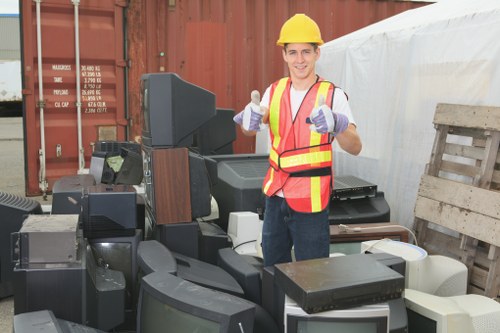 Training and competence are central to safe rubbish removal and clearance. Staff receive induction, task-specific training and refresher sessions on manual handling, COSHH awareness for hazardous substances, safe driving for vehicle teams, and the correct use of tools and lifting equipment. Competence is assessed and documented; apprentices and new workers are supervised until they demonstrate capability.
Equipment and vehicle maintenance follow a planned schedule to ensure reliability and safety during property clearance work. Ladders, trolleys, hoists, cutting tools and vehicles are inspected before use. Any defective equipment is removed from service and repaired by qualified personnel. This reduces the risk of injury during heavy or awkward rubbish disposal tasks and keeps rubbish collection vehicles safe for road use.
Manual handling procedures are used for all lifting and carrying. Teams are trained in safe lifting techniques and encouraged to use mechanical aids for bulky or heavy items commonly encountered in house clearance scenarios. The policy emphasises team lifts, correct posture and task rotation to reduce musculoskeletal injury.
Waste segregation and environmental controls are enforced to ensure compliance with waste management regulations and to protect public health. Hazardous items such as batteries, solvents, paints and electrical equipment are separated for specialist disposal. Sharp objects and biohazardous waste are secured in appropriate containers and handled only by trained personnel following strict procedures.
 Emergency procedures and incident management are established for all house clearance operations. This includes first-aid provision, accident reporting, spill response and a clear escalation route for serious incidents. All incidents are investigated to identify root causes and implement corrective actions to prevent recurrence, underpinning a learning culture in the rubbish company service area.
Health surveillance policies are applied where work activities expose staff to risks that may affect health over time, such as dust, noise or repeated manual handling. We encourage workers to report health concerns early and provide access to occupational health advice when required. The policy also covers welfare facilities and arrangements for staff wellbeing during extended clearances.
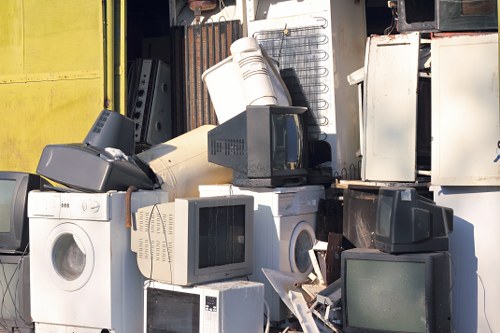 Monitoring, review and continual improvement form part of our governance arrangements. We undertake regular audits, inspections and performance reviews to measure compliance with this policy. Findings are used to update procedures, training and risk assessments. The management team will review this Health & Safety policy annually, or sooner in response to changes in legislation, operations or incident findings.
Key elements:
- Clear responsibilities for management, supervisors and staff in house clearance Gerrards Cross and surrounding service areas.
- Robust risk assessment and control measures for rubbish clearance and disposal tasks.
- Training and competence assurance for manual handling, vehicle operation and hazardous waste handling.
- Equipment maintenance and safe use of mechanical aids to reduce physical strain and incidents.
- Incident reporting and emergency response procedures to protect life and property.
All employees, contractors and stakeholders engaged in house clearance and rubbish removal activities are expected to support this policy by working safely and cooperating with control measures. The organisation believes that by embedding safety into day-to-day operations we deliver a safer service for clients and a healthier workplace for staff.
This policy does not replace statutory duties or detailed operational procedures; it provides the high-level commitments and expectations for safe house clearance service delivery within the rubbish company service area.
Signed and approved by management — the company will ensure resources are made available to meet the policy aims and will communicate this policy to employees and contractors. Regular review cycles will keep the policy aligned with best practice and regulatory changes.
